
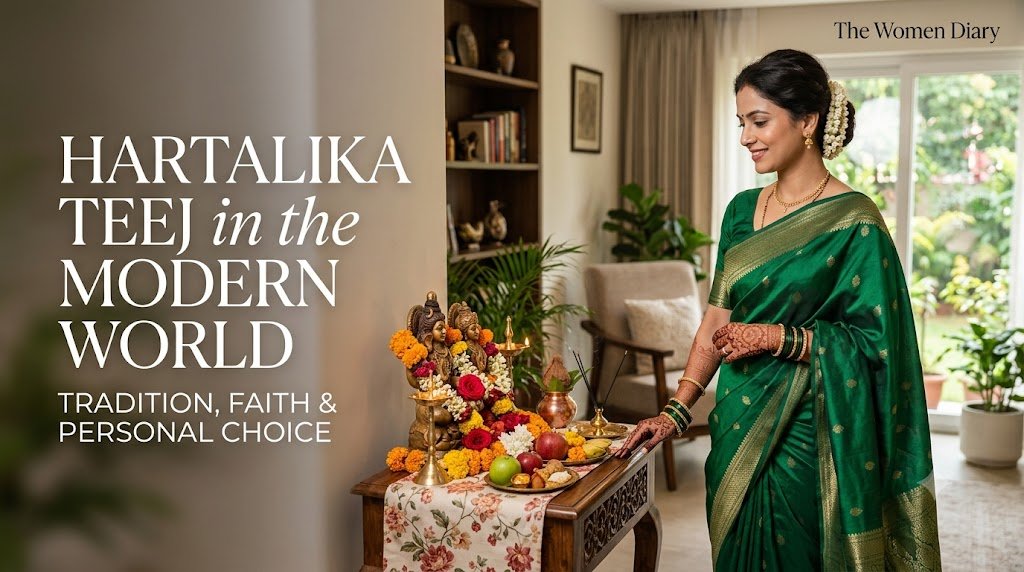
Hartalika Teej is a festival deeply rooted in Hindu traditions, faith and devotion. Observed primarily by women in many parts of India, the festival is associated with the worship of Goddess Parvati and Lord Shiva. Traditionally, women observe a fast, perform पूजा, listen to the Hartalika Teej vrat katha and pray for the well-being and happiness of their families.
However, as society continues to change, the way people celebrate traditional festivals is changing too.
Modern women today balance careers, families, health, personal responsibilities and individual beliefs. This has naturally created new conversations around traditions such as Hartalika Teej. Can ancient traditions adapt to modern lifestyles? Is fasting the only way to express devotion? And how can personal choice coexist with cultural traditions?
Perhaps the beauty of a festival lies not only in following rituals but also in understanding the meaning and emotions behind them.
Contents
ToggleWhat Is Hartalika Teej?
Hartalika Teej is an important Hindu festival associated with the devotion of Goddess Parvati towards Lord Shiva. The festival is observed with prayers, पूजा and traditional customs that may differ from one family or region to another.
The word Hartalika is traditionally connected with the story of Goddess Parvati being taken away by her companions to a forest, where she performed intense penance with the desire to marry Lord Shiva.
The festival is therefore often associated with devotion, determination and faith.
The Story of Goddess Parvati and Lord Shiva
According to Hindu tradition, Goddess Parvati wished to marry Lord Shiva. However, her father had reportedly made other plans for her marriage.
Determined to follow her heart and devotion, Parvati went to the forest with the help of her companions. There, she performed severe penance and prayed to Lord Shiva.
Her determination and devotion eventually resulted in Lord Shiva accepting her as his wife.
For many devotees, this story forms the spiritual foundation of Hartalika Teej. Beyond the rituals, it is also a story that can be viewed through the lens of determination, patience and the strength to stand by one’s choices.
The Traditional Way of Celebrating Hartalika Teej
Hartalika Teej is celebrated differently across India, and customs can vary significantly between families and communities.
Some traditional practices may include:
- Observing a fast
- Performing the पूजा of Lord Shiva and Goddess Parvati
- Preparing a special पूजा space at home
- Listening to or reading the Hartalika Teej vrat katha
- Wearing traditional clothes and jewellery
- Applying mehndi
- Spending time with family and other women celebrating the festival
Many married women traditionally observe the festival while praying for the health and well-being of their husbands and families. In some communities, unmarried women may also observe the vrat based on their personal beliefs and family traditions.
It is important to remember that there is no single way in which every family celebrates Hartalika Teej.
Hartalika Teej in the Modern World
The world has changed considerably over the generations, and so have people’s lifestyles.
Earlier, festivals were often celebrated within large joint families, where traditions were passed down directly from grandparents and parents to younger generations. Today, many people live away from their hometowns and families because of education, careers and marriage.
A woman living independently in a different city may experience Hartalika Teej very differently from someone celebrating it with her entire family.
Modern celebrations may involve a small पूजा at home, a video call with family members, visiting a temple after work or simply taking a few moments to connect with one’s faith.
The form of celebration may change, but for many people, the emotional and spiritual connection remains.
Balancing Tradition With a Busy Lifestyle
Modern women often manage multiple responsibilities every day.
From professional commitments and household responsibilities to raising children and caring for family members, finding time for elaborate celebrations can sometimes be challenging.
This does not necessarily mean that traditions are becoming less important. Instead, many people are finding ways to adapt them to their lifestyles.
Some women may:
- Perform a shorter पूजा because of work commitments.
- Celebrate the festival before or after office hours.
- Connect with family members virtually.
- Follow only certain rituals that are personally meaningful to them.
- Learn about the spiritual significance of the festival instead of focusing entirely on external customs.
Tradition does not always have to be an all-or-nothing experience.
Faith Is Personal
One of the most important conversations surrounding traditional festivals today is the idea of personal faith.
Every individual experiences spirituality differently.
Some women may follow every ritual strictly and find deep meaning in doing so. Others may participate in the पूजा without observing a complete fast. Some may adapt certain customs according to their circumstances, while others may choose not to participate in the festival at all.
These choices do not necessarily define the depth of a person’s faith.
For some, devotion may be expressed through fasting and traditional rituals. For others, it may come through prayer, gratitude, kindness and a personal spiritual connection.
Faith is deeply personal, and every individual should have the freedom to develop their own relationship with it.
Fasting and Personal Choice
Fasting is an important part of Hartalika Teej for many devotees. Some women observe a strict fast, while practices may vary according to family and regional traditions.
Women may choose to fast because of:
- Religious faith
- Family traditions
- Personal devotion
- A desire for spiritual discipline
- A sense of connection with their cultural roots
However, fasting is also a personal decision.
Not everyone may be physically able to observe a fast, especially a strict one. Health conditions, pregnancy, medications and other medical circumstances can affect whether fasting is appropriate for an individual.
Those with health concerns should make decisions carefully and consult a qualified healthcare professional when necessary.
No religious practice should require someone to ignore their health or well-being.
Is Fasting the Only Way to Celebrate?
For many people, fasting is an important expression of devotion. However, a festival can have different meanings for different individuals.
Someone may choose to celebrate Hartalika Teej by:
- Performing the पूजा
- Listening to the vrat katha
- Visiting a temple
- Spending time in prayer or meditation
- Learning about the story of Goddess Parvati
- Connecting with family and cultural traditions
The way a person celebrates a festival can be deeply personal.
What matters most is approaching traditions with understanding and sincerity rather than feeling pressured to follow practices simply because others expect it.
The Importance of Consent and Choice in Modern Traditions
Traditions are often passed from one generation to another, creating a valuable connection with our cultural roots.
However, traditions can be most meaningful when they are followed willingly.
There is a significant difference between participating in a ritual because it brings someone faith and happiness and participating because they fear judgment or social pressure.
Modern conversations around festivals are increasingly encouraging people to ask important questions:
Why do we follow a particular tradition?
What does it mean to us personally?
Do we genuinely wish to participate in it?
Respecting tradition and respecting individual choice do not have to be opposing ideas.
A tradition can remain meaningful while allowing individuals to participate in ways that suit their beliefs and circumstances.
What Can Modern Women Learn From Goddess Parvati’s Story?
The story associated with Hartalika Teej can be interpreted in many meaningful ways.
Determination
Goddess Parvati’s story represents extraordinary determination. She remained committed to her beliefs and continued her spiritual journey despite challenges.
For modern women, determination continues to be an important quality in every area of life, whether it involves building a career, pursuing an education, caring for a family or following personal dreams.
Inner Strength
The story also represents patience and inner strength.
Strength does not always have to be loud. Sometimes, it means quietly remaining committed to what matters to us.
The Power of Personal Choice
One of the most interesting aspects of the story is Goddess Parvati’s determination regarding her own life and future.
Viewed from a modern perspective, her story can encourage conversations about the importance of having a voice and making personal choices.
While interpretations of religious stories can differ, the message of determination and conviction continues to remain relevant.
Devotion and Strength Can Coexist
Women are often expected to choose between traditional values and personal independence. However, these ideas do not always have to conflict.
A woman can value her traditions while also having her own opinions and choices.
She can be spiritual and independent.
She can celebrate her cultural heritage while creating her own identity.
Celebrating Hartalika Teej Your Own Way
Modern celebrations do not always need to follow a single format.
You can make your Hartalika Teej celebration meaningful in ways that work for you.
Here are a few ideas:
Create a Peaceful Puja Space
Decorate a small area of your home with flowers and traditional पूजा items. Even a simple and peaceful space can help create a sense of spiritual connection.
Connect With Family
If you live away from home, a phone or video call can help you feel connected to your family traditions.
You can ask parents or grandparents about how they celebrated Hartalika Teej when they were younger. These conversations can help preserve traditions and family memories.
Wear Something Traditional
For many women, wearing a beautiful saree, suit or traditional jewellery is an enjoyable part of festival celebrations.
Celebrate in a way that makes you feel happy and connected to the occasion.
Learn the Meaning Behind the Festival
Instead of simply following rituals, take some time to understand their cultural and spiritual significance.
Understanding the stories behind a festival can create a deeper connection with it.
Make Space for Reflection
Festivals can also be an opportunity to slow down and reflect.
Spend a few quiet moments thinking about gratitude, relationships, personal growth and the things that bring meaning to your life.
Tradition Does Not Have to Remain Unchanged
Traditions have always evolved.
The way our grandparents celebrated a festival may be different from the way our parents did, and our celebrations may look different again for future generations.
Families move to new cities. Work schedules change. Technology becomes part of our lives. Social values evolve.
Yet festivals continue to bring people together.
A family that once gathered in the same home may now celebrate through video calls. A woman who cannot take an entire day off from work may perform her prayers at a different time. Someone living far from their hometown may recreate a small part of their family tradition in their own home.
Adapting a tradition does not necessarily mean losing respect for it.
Sometimes, adaptation is what allows traditions to continue.
Respecting Different Ways of Celebrating
Perhaps one of the most beautiful things we can learn from cultural diversity is that there is rarely just one way of doing something.
Different families may have different customs. Different regions may follow different rituals. Every individual may have a different relationship with faith.
Instead of judging how someone else celebrates Hartalika Teej, we can choose to respect their beliefs and circumstances.
Some women may observe a strict fast.
Some may modify their fasting practices.
Some may simply participate in the पूजा.
Some may not celebrate the festival at all.
Respecting another person’s choice does not reduce the value of our own traditions.
In fact, it can make our communities more understanding and inclusive.
Frequently Asked Questions About Hartalika Teej
Can unmarried women celebrate Hartalika Teej?
Practices can vary between families and regions. In some traditions, unmarried women also observe the festival based on their personal beliefs and family customs.
Is fasting compulsory during Hartalika Teej?
The importance and practice of fasting depend on individual beliefs, family traditions and regional customs. Personal circumstances, including health, should also be considered.
Can Hartalika Teej traditions be modified?
Traditions often vary between families and communities and may naturally adapt over time. Individuals may choose to participate in ways that align with their beliefs and circumstances.
What is the significance of Goddess Parvati during Hartalika Teej?
Goddess Parvati is central to the story associated with Hartalika Teej. Her devotion, determination and commitment to her beliefs are important aspects of the festival’s spiritual significance.
Conclusion: Tradition, Faith and the Freedom to Choose
Hartalika Teej is much more than a collection of rituals. For many people, it represents faith, devotion, cultural identity and a connection with generations of tradition.
At the same time, the world in which we live today is different from the world of previous generations.
Modern women have different lifestyles, responsibilities, beliefs and circumstances. There cannot be a single definition of what it means to celebrate a festival or express one’s faith.
Some women may find meaning in observing every traditional ritual. Others may choose to adapt certain practices. Some may connect with the festival through prayer and reflection rather than fasting.
All of these experiences can be personal and meaningful.
Perhaps the true beauty of traditions lies not only in preserving them exactly as they were but also in understanding their deeper meaning and allowing each generation to build its own connection with them.
This Hartalika Teej, let us celebrate faith with understanding, traditions with respect and personal choices with kindness.
Because tradition and modernity do not always have to stand on opposite sides. Sometimes, they can grow beautifully together.