
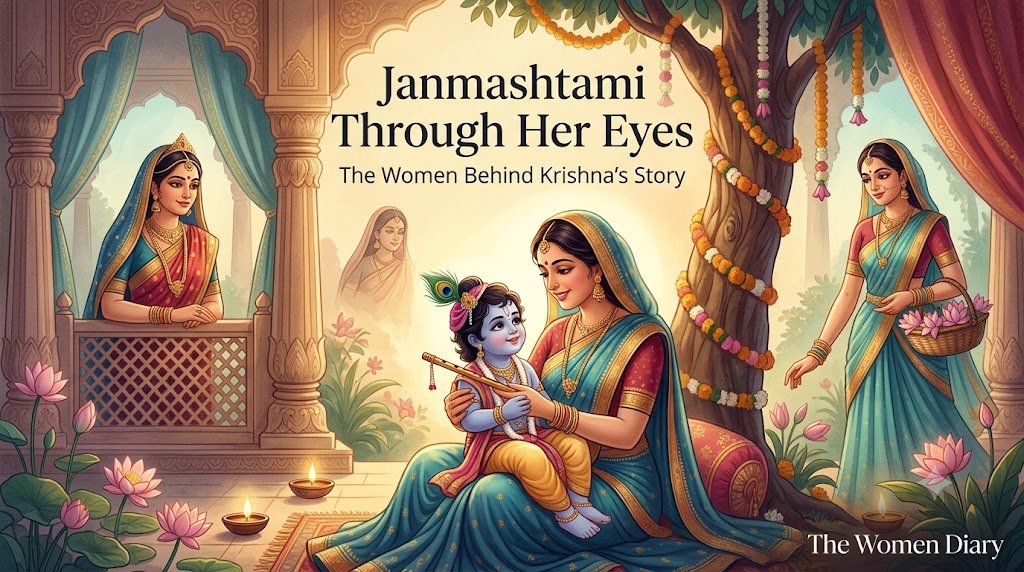
Every year, millions of people across India and around the world celebrate Janmashtami, the Hindu festival marking the birth of Lord Krishna. Homes and temples are decorated, devotional songs fill the air, people fast and pray, and many gather at midnight to celebrate the moment traditionally associated with Krishna’s birth.
But what happens when we look beyond the central figure of Krishna?
His story is also the story of the women around him.
It is a story of a mother who gave birth to a child she could not raise, another who raised him without knowing the extraordinary destiny that awaited him, and women whose love, devotion and strength became deeply woven into the cultural imagination surrounding Krishna.
Looking at Janmashtami through their eyes offers a different way of understanding an ancient festival—one that brings motherhood, love, resilience and women’s voices into the conversation.
Contents
ToggleJanmashtami: More Than the Birth of Krishna
For those unfamiliar with Hindu traditions, Janmashtami celebrates the birth of Krishna, one of the most widely revered deities in Hinduism.
According to Hindu tradition, Krishna was born during a time of fear and oppression. His birth was connected to a prophecy that threatened the rule of King Kansa, who imprisoned his sister Devaki and her husband Vasudeva.
The story that follows is filled with extraordinary events. But at its heart are deeply human experiences: fear, separation, motherhood, protection and hope.
While Krishna is the hero of the story, the women around him are not simply background characters. Their experiences offer another way to understand the world into which Krishna was born.
Devaki: The Mother Who Had to Let Go
Devaki’s story is perhaps one of the most emotionally powerful parts of Krishna’s birth narrative.
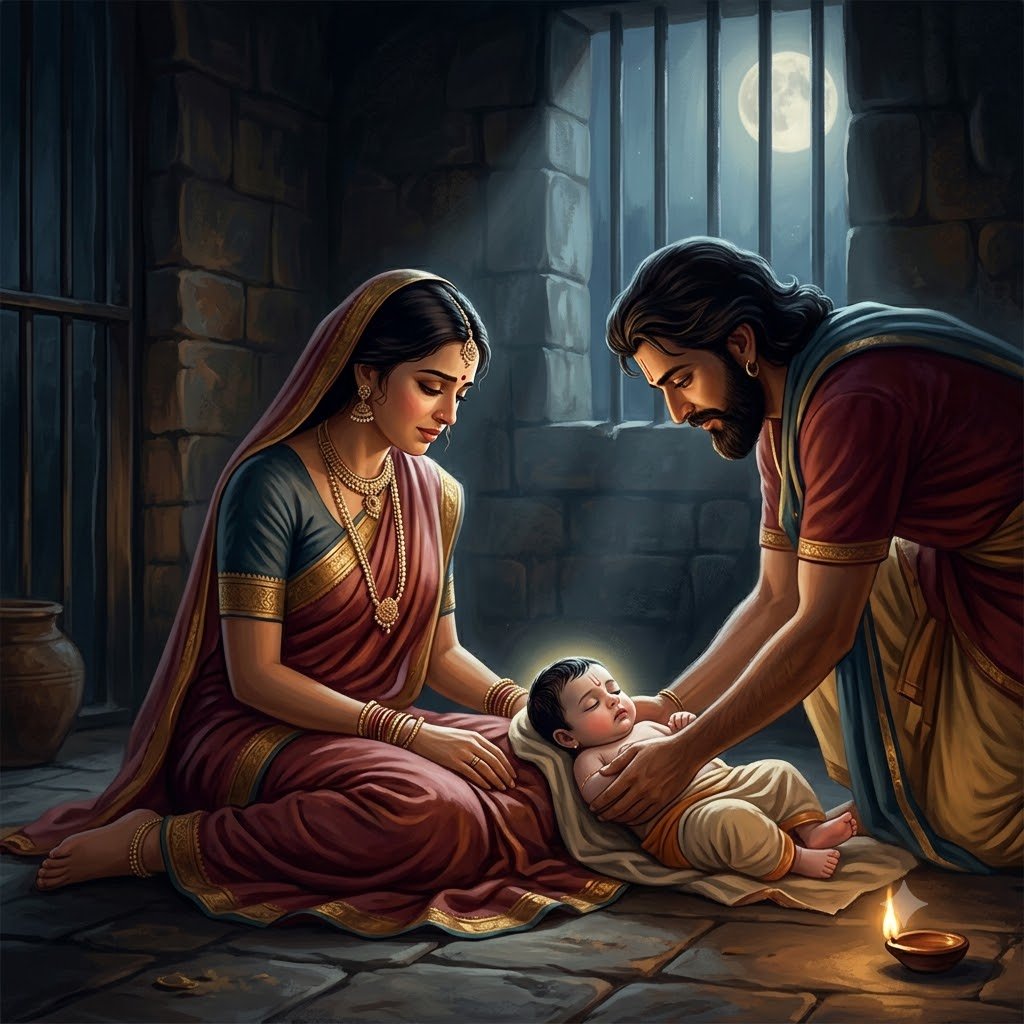
According to Hindu tradition, Devaki was imprisoned alongside her husband, Vasudeva, by her brother Kansa. A prophecy had warned Kansa that one of Devaki’s children would eventually bring about his downfall.
As a result, Devaki lived through unimaginable fear and loss.
When Krishna was born, he could not remain with her. To protect the newborn child, Vasudeva carried him away from the prison and took him to Gokul, where he would be raised by Yashoda and Nanda.
From a woman’s perspective, Devaki’s story raises a profoundly human question: What does it mean to become a mother but be denied the opportunity to raise your child?
Her story is often told as part of Krishna’s extraordinary destiny. Yet behind the divine narrative is the experience of a woman facing circumstances beyond her control.
Today, Devaki’s story can invite us to think about motherhood in all its complexities. Not every mother gets to experience motherhood in the way she imagined. Life, loss, distance and circumstances can reshape that journey in unexpected ways.
Devaki reminds us that motherhood is not always a simple story of giving birth and raising a child. Sometimes, it is also a story of love, separation and letting go.
Yashoda: The Woman Who Raised a God
If Devaki represents the pain of separation, Yashoda represents the everyday experience of nurturing.
Yashoda raised Krishna in Gokul and is at the heart of some of the most beloved stories from his childhood. She knew him as her mischievous little boy—the child who stole butter, played pranks and filled her life with endless surprises.
One of the most famous stories describes Yashoda asking young Krishna to open his mouth after suspecting that he had eaten mud. Instead, she is said to have witnessed the entire universe within it.
Yet despite these extraordinary moments, Yashoda’s relationship with Krishna is often remembered for something deeply ordinary: a mother’s love for her child.
She fed him, protected him, worried about him and disciplined him.
Her story challenges a narrow definition of motherhood.
Yashoda was not Krishna’s biological mother, but she was the woman who raised him. Her story reminds us that parenting is not defined by biology alone. Love can grow through care, presence and the countless small acts that often go unnoticed.
In today’s world, her story may resonate with adoptive parents, step-parents, grandparents, guardians and caregivers. It reminds us that families can be created and sustained in many different ways.
Radha: More Than a Love Story
For many people, the names Radha and Krishna are inseparable. Their story has inspired poetry, music, dance and art for centuries.
However, Radha’s place in Krishna traditions is complex. Her prominence varies across different Hindu texts and regional traditions, with many of the most influential stories and devotional interpretations developing over time.
This makes Radha’s story particularly fascinating.
She is often presented simply as the woman who loved Krishna. But reducing her to a romantic character overlooks the deeper meaning she holds within many devotional traditions.
Radha has come to represent love, longing and devotion. In some spiritual interpretations, her relationship with Krishna represents the soul’s longing for connection with the divine.
But perhaps there is also another way to look at her story.
How often are women remembered primarily through their relationship with someone else?
Looking at Radha from a modern perspective allows us to ask questions about emotional identity, love and individuality. Her story can remind us that a woman’s emotional world is complex and deserves to be understood beyond the role she plays in someone else’s life.
Radha is not simply a supporting character in a love story. Through centuries of art and tradition, she has become a powerful cultural and spiritual figure in her own right.
The Gopis: Community, Celebration and Devotion
The stories of Krishna’s life in Vrindavan are also closely connected with the Gopis, the women and milkmaids traditionally associated with his early life and devotional stories.
Their stories have been interpreted in many different ways across Hindu traditions.
For some, they represent devotion to the divine. For others, their stories are closely connected to the cultural traditions of Vrindavan, where music, dance and celebration became important expressions of spirituality.
From a modern perspective, the Gopis also remind us of the importance of female communities.
Women have historically played a significant role in preserving cultural traditions. They pass down songs, recipes, rituals, stories and customs from one generation to another.
Even today, many festivals continue to survive and evolve because of the communities that keep these traditions alive.
Whether through singing devotional songs, preparing festive food, decorating homes or sharing stories with children, women often play an important role in connecting the past with the present.
Rohini and the Women We Often Forget
Not every woman connected to Krishna’s story receives the same attention.
Rohini, the mother of Balarama and an important figure within Krishna’s extended family, is one example.
Her presence reminds us of a larger issue that extends far beyond mythology.
When we tell stories about heroes, whose stories do we remember?
Ancient stories, like modern history, often place great emphasis on central figures. The people surrounding them—the mothers, sisters, friends, caregivers and companions—can gradually fade into the background.
Looking more closely at Krishna’s world allows us to rediscover some of these voices.
It also encourages us to ask an important question:
Whose stories are we missing when we focus only on the hero?
Janmashtami in the Modern World
Today, Janmashtami is celebrated in countless ways across India and around the world.
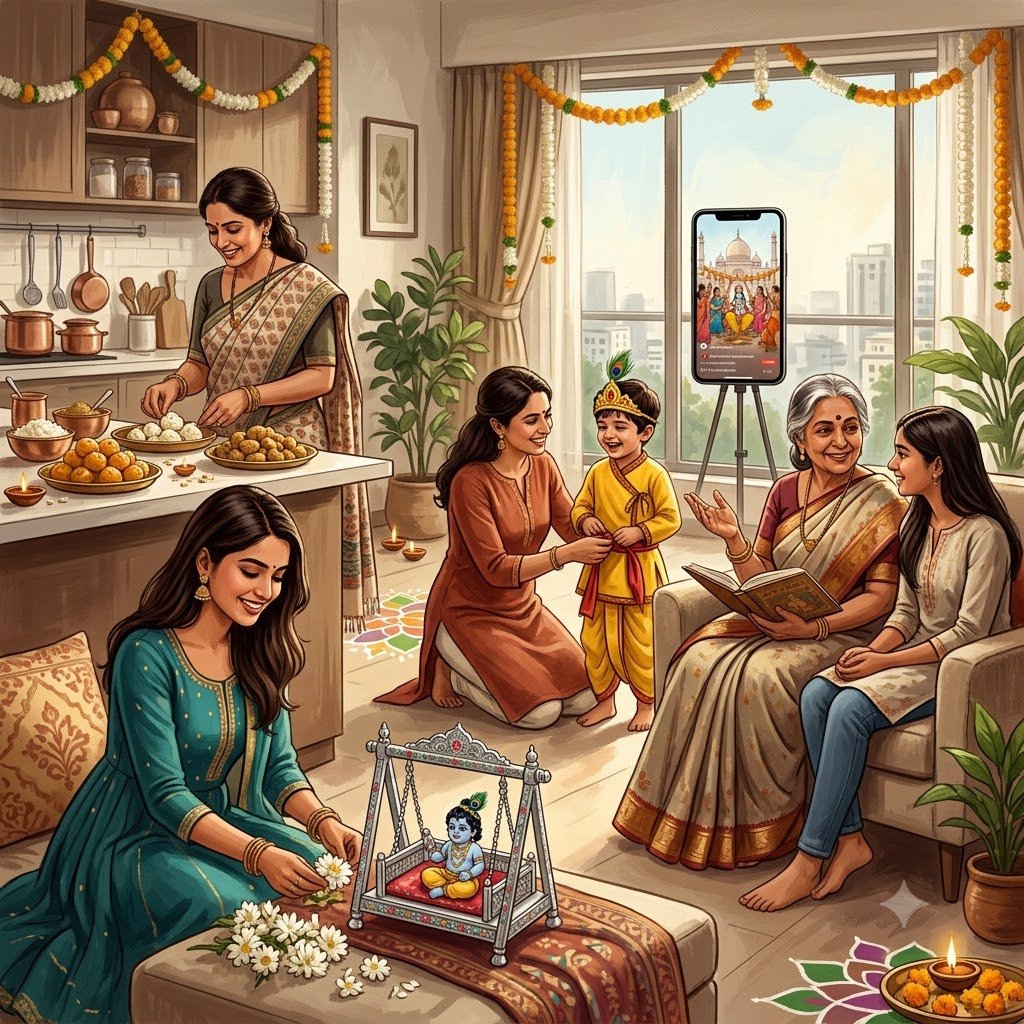
Many devotees fast and visit temples. Homes are decorated with flowers and colourful ornaments. Some families create small cradles for baby Krishna, while children are dressed as Krishna or Radha.
In Maharashtra and other parts of India, Dahi Handi celebrations have become an energetic and well-known part of the festival. Human pyramids are formed to reach and break a pot traditionally associated with Krishna’s childhood love for butter and dairy products.
For Indian communities living outside India, Janmashtami can also become a way of maintaining a connection with cultural heritage.
But like every living tradition, celebrations continue to evolve.
Today, people share Janmashtami greetings online, attend virtual events and introduce traditional stories to younger generations in new ways. For some, the festival is primarily religious. For others, it is cultural, spiritual or deeply connected to family memories.
There is no single modern experience of Janmashtami.
And perhaps that is one reason ancient festivals continue to remain relevant—they allow every generation to find its own connection to the stories.
What Can Women Today Take From These Stories?
Ancient stories do not need to be understood in exactly the same way by every generation.
Their meanings can evolve as we ask new questions.
Devaki and Resilience
Devaki’s story reminds us that strength is not always about having control over our circumstances.
Sometimes, resilience means surviving experiences we never chose.
Yashoda and Nurturing
Yashoda reminds us that love is often expressed through everyday acts of care.
Motherhood and nurturing are not defined by a single experience or biological connection.
Radha and Emotional Identity
Radha’s story encourages us to look beyond simplistic ideas about women and love.
A woman can love deeply while still possessing her own emotional and spiritual identity.
The Gopis and Community
The stories surrounding the Gopis highlight the importance of community and shared experiences.
In today’s increasingly individualistic world, connections with other women can provide friendship, support and a sense of belonging.
The Women Whose Names Are Less Remembered
Finally, these stories encourage us to look more carefully at the people who exist beyond the central hero.
Sometimes, the most meaningful stories are found at the edges of the narrative.
Why Ancient Stories Still Matter
For a global audience, stories from Hindu mythology may feel distant from modern life.
They come from another time, another culture and a world filled with divine beings, prophecies and extraordinary events.
Yet the emotions within these stories remain remarkably familiar.
A mother fears for her child.
A woman experiences separation and loss.
A caregiver forms a deep bond with a child.
Someone loves deeply and searches for meaning through that love.
Communities come together to celebrate traditions they have inherited from generations before them.
These experiences are not limited by geography or time.
Perhaps that is why stories continue to survive for centuries. Each generation finds new questions to ask and new meanings to discover.
Seeing Janmashtami Through Her Eyes
Janmashtami celebrates the birth of Krishna, but his story does not exist in isolation.
It unfolds through Devaki’s courage, Yashoda’s nurturing love, Radha’s enduring presence in devotional traditions and the lives of many other women whose stories surround his own.
Looking at Janmashtami through their eyes does not take anything away from Krishna’s story.
Instead, it allows us to see it more fully.
It reminds us that behind every great story are people whose experiences may not always occupy the centre of the narrative. Mothers, caregivers, lovers, friends and communities all contribute to the worlds in which heroes are created.
This Janmashtami, perhaps we can celebrate not only the birth of Krishna but also the women whose love, strength, resilience and stories helped shape the world around him.
After all, sometimes seeing an ancient story differently helps us discover something new—not only about the past, but also about ourselves.