
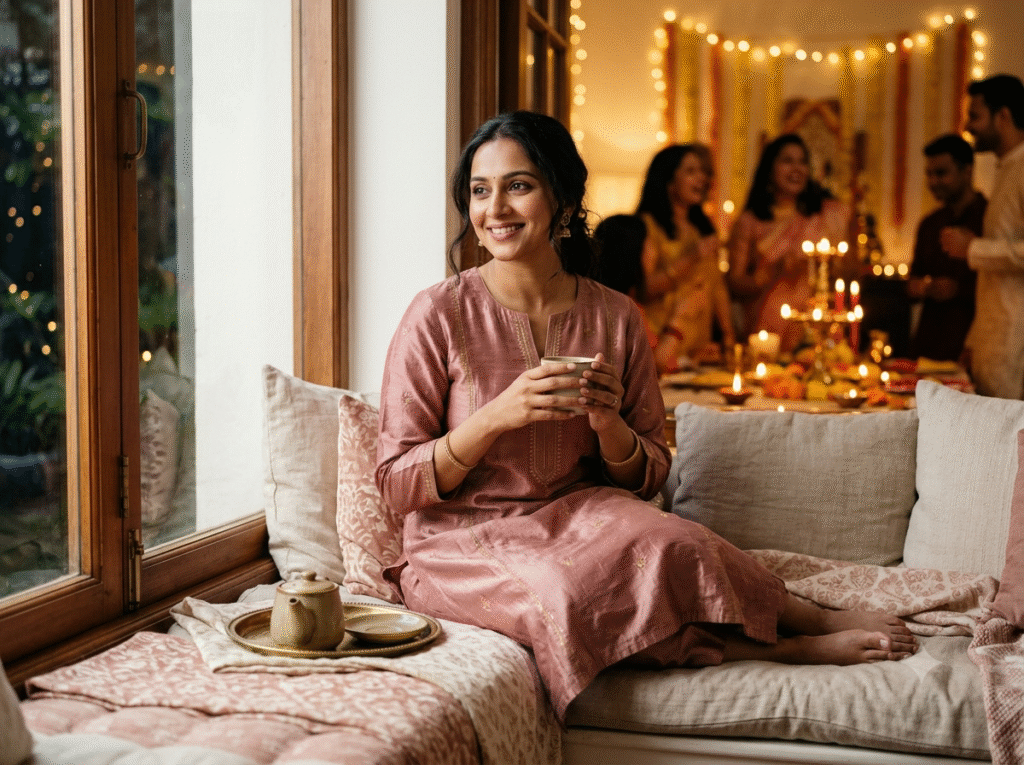
You get home from a wedding, a family dinner or a friend’s birthday feeling warm and glad you went. An hour or two later, you are slumped on the sofa, ignoring your phone and wondering what is wrong with you. Many of us settle the question quickly: “I must be an introvert.”
The research suggests the story is more interesting, and a good deal kinder. With Diwali only a week away and a season of gatherings following it, this is a good moment to look at what science actually says about the tiredness that follows time with people.
Happy now, tired later
Psychologist Sointu Leikas and a colleague at the University of Helsinki asked 48 people to report on their behaviour, mood and tiredness five times a day for 12 days. In the moment, being sociable and talkative went with a better mood and less fatigue. About three hours later, the same behaviour predicted more tiredness. The number of people someone had met helped explain that delayed effect.
Here is the part that surprises people. In that study, personality traits did not change the pattern. A later study by Leikas with 74 participants found a similar link between sociable behaviour and tiredness two to three hours afterwards, and it noted that a person can be tired and happy at the same time.
So the drained feeling after a lively evening appears to be a fairly common human response, not a verdict on your personality.
What this does not prove
Please hold this finding lightly. Both studies were small, and Leikas herself has said that larger studies are needed before anyone can be confident. Nothing here shows that introverts and extraverts are identical, or that introversion is not real. It simply suggests that “I get tired after socialising” is not a reliable test for which one you are.
The forecast problem
A second finding pairs well with the first. Researchers led by John Zelenski at Carleton University found that people who score as introverts tend to predict that acting outgoing will feel worse than it actually does. In their experiments, the enjoyment turned out to be higher than expected. His lab also reports that introverts did not show a drop in performance on a demanding thinking task after acting extraverted, and that they said they felt more authentic in the moment when they did.
Older work points the same way. William Fleeson at Wake Forest University followed 46 college students and found that people, introverts included, were happier in moments when they behaved in a talkative, energetic way. A 2020 experiment by Sonja Lyubomirsky and Seth Margolis went further. Participants asked to act more talkative, assertive and spontaneous for a week reported higher wellbeing, while a week of acting reserved lowered it. The participants were students and the weeks were short, so nobody yet knows how this plays out over months.
Put the two findings together and a gentle picture emerges. The dread before an event may be exaggerated, while the tiredness after it may be real. Both can be true on the same evening.
Planning around your energy, not against it
If you feel drained, there is no need to cancel everything. Treat recovery as part of the plan. Leave an empty hour after a big event. Decide in advance when you will leave. Notice whether crowds, noise, small talk or hosting wears you down most, because the research hints that how many people you meet matters.
For many women, especially during festivals, the evening also involves cooking, hosting and keeping everyone comfortable. That is a different load from simply attending. The studies above did not measure it, so take this as an editorial observation rather than a research finding, but it is worth counting honestly when you work out why you are tired.
If you are reading this on behalf of someone you love, here is a small note. When a partner, sister or friend goes quiet after a gathering, it is rarely a comment on you or on the evening. A short rest usually helps more than a long conversation about it.
One caution. Ordinary tiredness after a busy social day is common. If you feel exhausted most days, dread all contact with people, or notice a low mood that lingers, please speak to a doctor or a counsellor.
A better question than “Am I an introvert?”
Labels are handy, but they can quietly shrink our choices. Instead of asking what type you are, try asking what this evening cost you, what it gave you, and what you need next. That question is far more useful for planning your week, and it leaves room for you to be someone who loves a party and also needs a quiet Sunday afterwards.
SOURCES AND REFERENCES
- Journal of Personality. Leikas, S. and Ilmarinen, V. J., “Happy Now, Tired Later? Extraverted and Conscientious Behavior Are Related to Immediate Mood Gains, but to Later Fatigue.” Vol. 85, issue 5, October 2017. https://doi.org/10.1111/jopy.12264
- Heliyon. Leikas, S., “Sociable behavior is related to later fatigue: moment to moment patterns of behavior and tiredness.” Vol. 6, issue 5, e04033, May 2020. https://pmc.ncbi.nlm.nih.gov/articles/pmc7260435
- PsyPost. Dolan, E. W., “Study: Being sociable makes you tired, even if you’re extroverted,” 12 September 2017. https://www.psypost.org/study-sociable-makes-tired-even-youre-extraverted
- CU Happiness Laboratory, Carleton University. “Should introverts act more extraverted?” Page last modified 20 May 2026. https://carleton.ca/happinesslab/should-introverts-act-more-extraverted/
- Journal of Personality and Social Psychology. Zelenski, J. M. et al., “Personality and affective forecasting: Trait introverts underpredict the hedonic benefits of acting extraverted.” Vol. 104, issue 6, 2013, pages 1092 to 1108. http://psycnet.apa.org/psycinfo/2013-13271-001/
- APA Monitor on Psychology. Dittmann, M., “Acting extraverted spurs positive feelings, study finds,” April 2003. https://www.apa.org/monitor/apr03/acting
- Journal of Experimental Psychology: General. Margolis, S. and Lyubomirsky, S., “Experimental manipulation of extraverted and introverted behavior and its effects on well being.” Vol. 149, issue 4, 2020, pages 719 to 731. http://dx.doi.org/10.1037/xge0000668